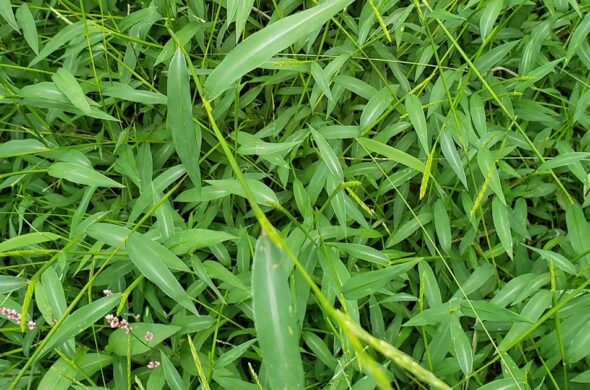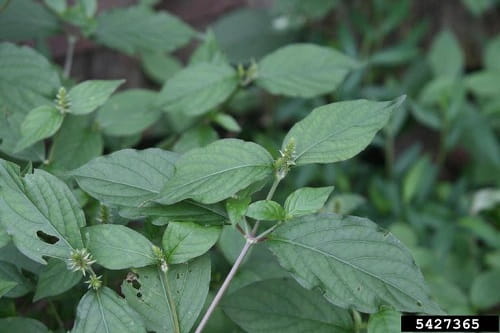
With the plentiful rainfall and warm temperatures that we have experienced this late spring, the invasive plants are being spotted earlier than usual! Now is the time to start identifying and removing Chaff Flower (Achyranthes japonica)! Chaff can grow nearly anywhere, in partial shade to full sun, in drier areas and wetter areas. Woodlands, landscape beds, alleyways, you name it! Chaff is a floodplain species that can be spread by flooding conditions, which makes it hard to control. This invasive plant has only invaded Louisville’s Olmsted Park System in the last five years, so early detection and monitoring are high priorities in maintaining our high-quality natural areas. This perennial herbaceous plant grows densely and produces thousands of seeds each year, creating a monoculture that reduces native plant populations.
Chaff Flower grows 3-5 feet tall and has a spread of nearly 3 feet when mature. Leaves are elliptical shaped with pointed tips and branching arranged oppositely on the stem. The leaves have entire margins with arching veins; two traits that can help differentiate it from native lookalikes (such as White Snakeroot and nettles with serrated leaf margins). The chaff stems are squarish, and nodes frequently have a reddish color. The flowers form in small clusters from June to July on a bottle-brush like spike, which elongates as the plant matures. As seeds are formed, these leggy spikes assist seeds in contacting those who pass by, where they hitch a ride to another locale. Even during the winter, the plant stems can be found upright, although leafless, with remaining seeds waiting to spread. Seeds are also dispersed by mowing, so cleaning equipment between sites is important to mitigate spreading.
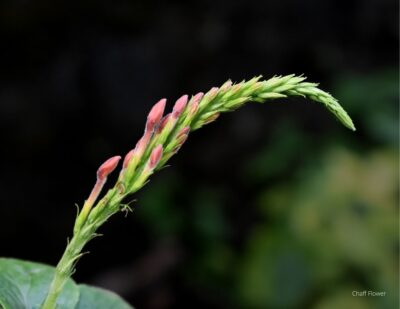
Chaff flower does not pull out of the ground easily, like garlic mustard, instead it has a root collar that must be dug out for removal of the plant. Repeated cutting can prevent seeding, but it will not kill the plant. Therefore, the best management practice for mitigating invasions is judicious herbicide treatment before flowers form. Chaff is spreading fast throughout the park system, but we are deploying our best management practices to ensure it does not take over our woodlands and landscape areas!
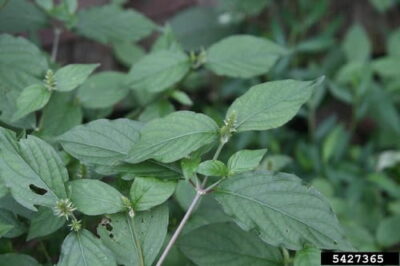
To end on a good note, we will review the native nettles that can look like the invasive chaff. Nettles have a high value for wildlife and are used in herbal medicine. They have serrated leaf margins, alternate branching along the stem, and some are known for prickly hairs along petioles, stems, and leaves. In our park system, we observe Wood Nettle (Laportea canadensis) and Clearweed (Pilea pumila). While visually similar at first, the stinging hairs on the Wood Nettle are hard to miss, and something you may feel later if you brush against the plant. This serves as a natural barrier that prevents overgrazing by deer, and other native plants (like Jewelweed) often grow amongst nettle to make the most of the natural defense. Clearweed gets its name from a partially translucent stem (smooth, no hairs) and is more tolerant to disturbance than wood nettle. These natives are found along Beargrass Creek, the tributaries of Iroquois Park, and the Ohio River terraces of Shawnee and Chickasaw Park. Louisville is forever fortunate to have a park system that links these natural wonders together for all to enjoy!
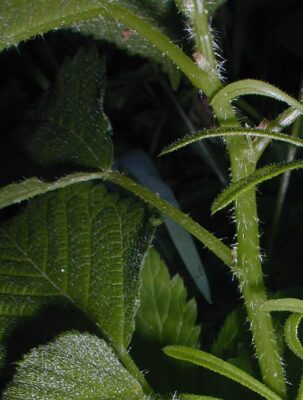
Photo credits for nettle and clearweed to Dr. John Hilty, Illinois Wildflower.
Chaff photo creds to Chris Evans, University of Illinois.
Find something similar: News Cherokee Park Chickasaw Park Iroquois Park Shawnee Park