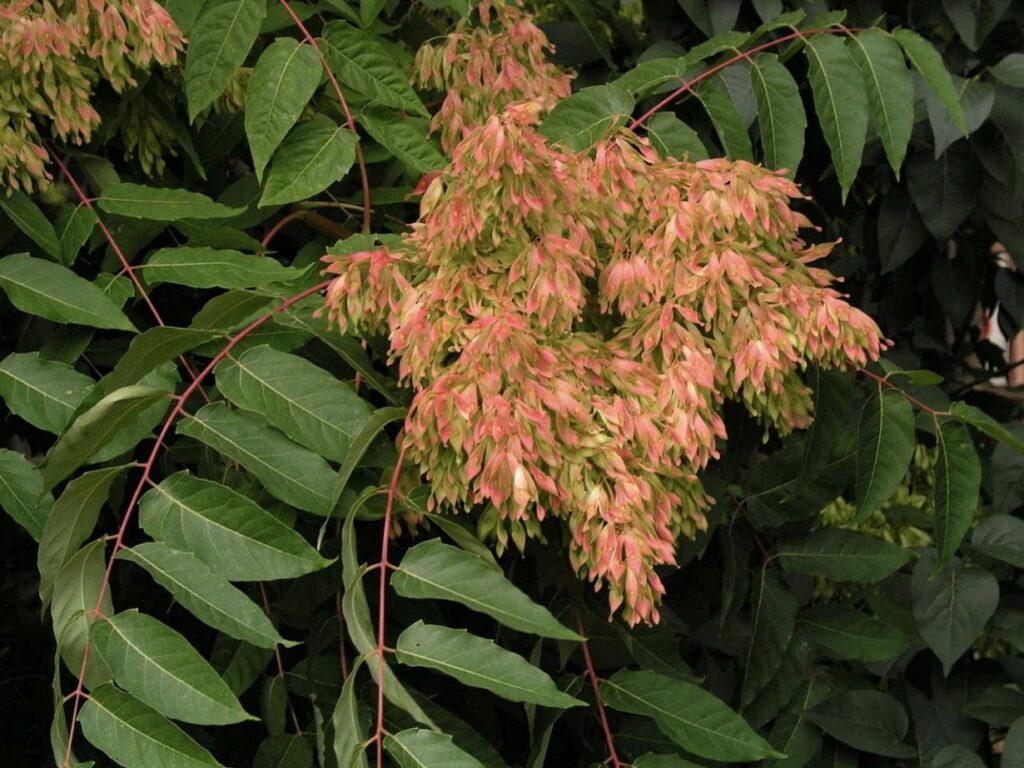
Tree of Heaven, does a tree by any other name smell as sweet?
We would hope so, as another common name for this invasive tree is “stinking sumac”. The Latin name (Ailanthus altissima) suggests it is a very tall tree growing for the sky, which is more apt than calling it heavenly! Tree of Heaven (TOH) is a fast-growing species, highly invasive species. The field team actively manages this threat by collecting data on its whereabouts and treating when appropriate. The tree is fast spreading, sending up multiple underground shoots to form colonies or by producing prolific seed that will eventually colonize an area.
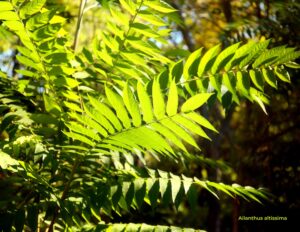
An identifying trait of Tree of Heaven can be the shape it grows in, tall with leggy branching. Bark is smooth and light brown on young trees, turning brown to gray as the tree ages. As the tree matures, the bark becomes more unique and is said to resemble the skin of a cantaloupe. Leaves are pinnately compound and have a smooth margin with two notches at the base of each leaflet, the leaflet shape often described like an arrowhead. The winged seeds, or samaras, on the Tree of Heaven can also be helpful in identification. These seeds (also known as helicopter seeds) can be seen hanging in large clusters and become red as they mature. Each canopy tree can disperse over 300,000 seeds to the wind each year!
Tree of Heaven has some native lookalikes, such as sumacs, walnuts, and hickories; but if you follow your nose, you shouldn’t go astray! Simply crumple some leaves and if you start to smell rancid peanut butter, you have a Tree of Heaven! The lookalikes mentioned have serrated leaf margins, in contrast to the smooth margins of the TOH.
We utilize Geographic Information System (GIS) maps in monitoring and treatment of invasive species to be able to track where plants are spreading and to ensure we have accurate locations of treated areas. Treatment of some plants, like Tree of Heaven, can be very time sensitive and improper treatment creates a bigger problem. So, if we spot a tree throughout the year, we will mark the location and return in early fall when conditions are appropriate. If a Tree of Heaven is cut too early, it will send up “root suckers” which form dense stands. For effective treatment, we pair proper time of year with hatchet cuts spaced every inch around the base of a tree and insert chemical into the cuts, where the tree slowly draws chemical into the roots in a way that will not trigger surplus overground growth.
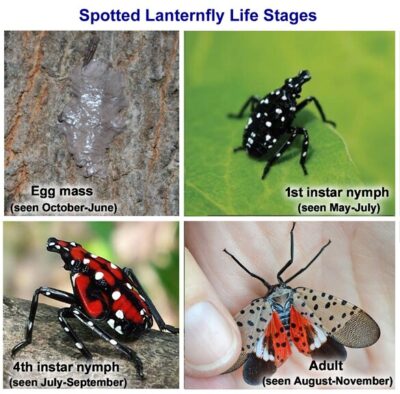
Now another related threat is on the way, the Spotted Lanternfly! Tree of Heaven is the preferred host plant for the Spotted Lanternfly (SLF), therefore removing one invasive can help slow the spread of another. However, SLF will also feed on native trees and crops, such as maples, oaks and grapes, as they establish in an area. Their voracious appetite is accompanied by their unpleasant excretion that causes the growth of a fungus called sooty mold. The fungus stresses the plant and leaves it vulnerable to diseases and additional pests. The lanternfly has been moving south, impacting wineries and forestry along the way. It goes to show how our work has benefits beyond the parks.
Find something similar: News