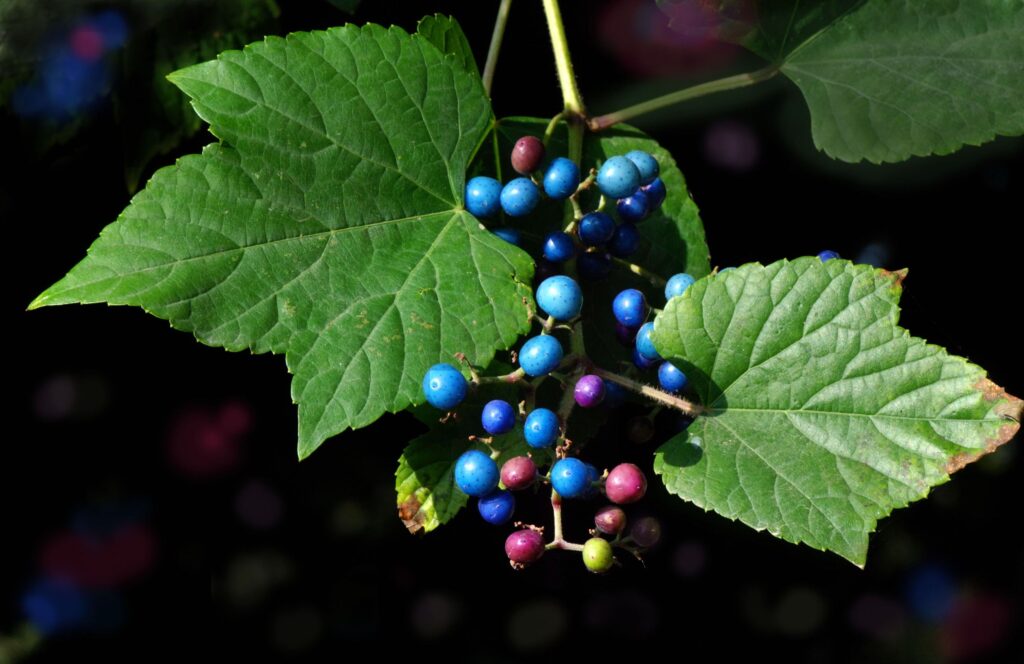
The golden hour of summer is here; native wildflowers are getting ready for their finale. Goldenrod, white snakeroot, and ironweed are the stars of the show. However, there are nonnative, invasive species trying to steal the show! One of these plants is commonly known as Porcelain Berry vine, known for its beautiful late-season multi-colored berries of blue, purple, and pink.
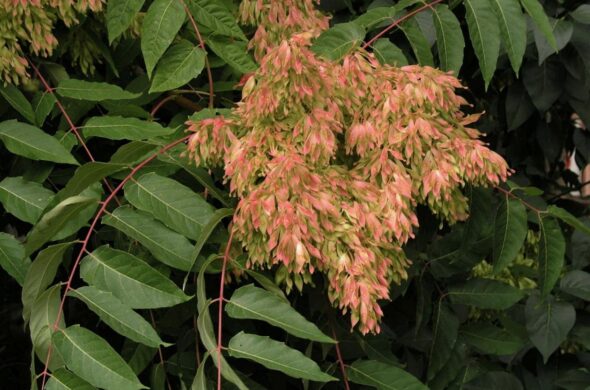
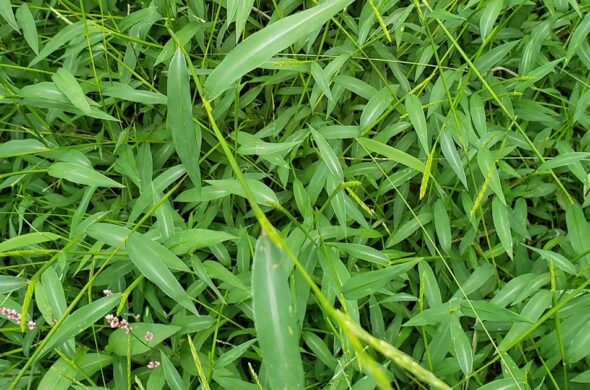
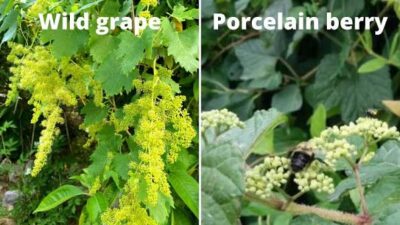
Porcelain berry (Ampelopsis brevipedunculata) was introduced by the horticulture trade for these showy berries, but the plant aggressively grows in sun to partial sun and can create a thick mat with thousands of seeds in just one growing season. This vine is a perennial, deciduous vine that can grow up to 40 feet long. Leaves are alternate, simple, variably shaped (from heart shaped to deeply lobed) with toothed edges, and shiny undersides with hairs only along the veins. The vine produces small greenish-yellow flowers that develop into hard berries in various colors. Porcelain berry looks similar to native grapevines until it begins to produce its colorful berries. The flower clusters of porcelain berry hang upright, while the grape (Vitis species) flowers dangle down in elongated clusters. Grapes produce flowers and fruits in midsummer, so you can find remnant stalks the fruits would have been on.
The Team for Healthy Parks observes porcelain berry along woodland edges, tree islands in turf, and within prairies. Whether climbing up a tree or creeping along the ground, porcelain berry vine will grow over other vegetation, often killing it. As our woodlands areas are fragmented by roads, there are miles of woodland edges to monitor! This vine can also make its way into intact forests via canopy gaps, where more sunlight is available after a tree falls. It favors disturbance and takes advantage of flood damage or bank erosion. Porcelain berry grows quickly and forms thick mats that outcompete native vegetation for light, water, nutrients and space. Once established, it will climb and shade out young shrubs and seedlings on the forest floor. Seeds are distributed by birds, small mammals and water. A high seed germination rate accompanied by its propagation through root fragments makes this vine species of particular concern and difficult to manage. As this plant is only in a handful of parks in our area, it is important to act early to remove it once it is detected.
To treat this plant, the Team for Healthy Parks will cut vines at their base, inhibiting their growth on trees or away from woodland edges. The vine stump is then treated with chemical, the vine that climbed into the canopy is disconnected from the root system and will die. The cut stump practice works best for smaller infestations where workers can locate the source of each vine. In areas with dense infestations, we use selective herbicides in the fall, when the plant is drawing resources into its roots and will be most affected by an application. This application is done on the leaves of the plant and is known as foliar spraying. Whether your infestation is big or small, the best time to start removal is today! You can help by cutting this plant in your own yard, to limit it spreading further into your neighborhood or local natural area.
-Lauren Hendrickson, Natural Areas Specialist
Find something similar: News Projects Cherokee Park Iroquois Park Shawnee Park