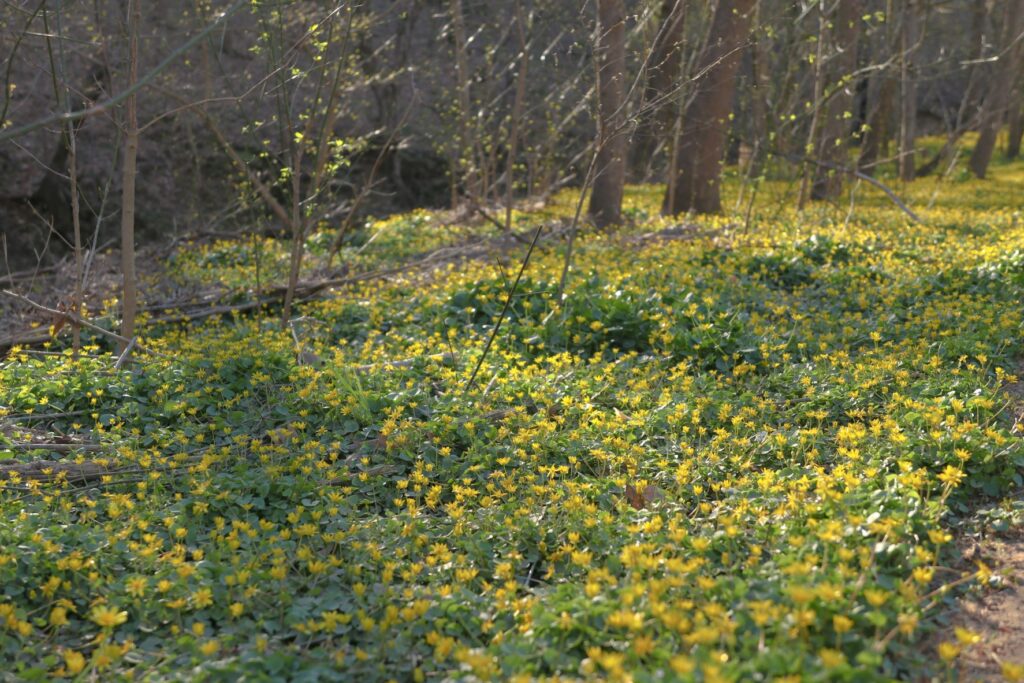
Long before the floodplains of Cherokee Park are blanketed in yellow spring flowers, Olmsted Park Conservancy’s Team for Healthy Parks is on the hunt for this plant’s telltale foliage. It’s not a treasure hunt but rather a seek and destroy mission. Yes, we are talking about Fig Buttercup! We know you love to see them, but those Instagram-worthy flowers are terrible for a healthy ecosystem.
This yellow-flowered plant is a perennial native to Europe and western Asia, where climate and natural predation keep populations from growing rampantly. However, in our area, the fig buttercup forms dense mats of leaves that suppress other plants from growing, thus displacing any native plants that would be beneficial to the native habitat. This is especially destructive along stream banks, where native plants with roots deep enough to control erosion have long been bullied out by this tough little flower. Roots and bulbils of fig buttercup only exist in the first few centimeters of soil, which does not mitigate erosion but instead makes it easier for plants and soil to spread along waterways during flood events.
When the Team is on the hunt for early signs, they are looking for the emergence of heart-shaped leaves with smooth margins (not to be confused with violets, with heart-shaped leaves with serrated leaf margins). Fig buttercup sends up new leaves from underground tubers before native flowers emerge, which allows the nonnative to get a head start on gathering resources and occupying space (a common characteristic of an invasive plant). Both leaves and petals of the buttercup are glossy in appearance due to a waxy coating on each structure. A trait that makes this nonnative buttercup unique from native buttercup species is the presence of bulbils. A bulbil is a propagation structure that forms on the parent plant and produces a genetically identical plant when dislodged. Fig buttercup often does not produce seed, making propagation the main dispersal method for this plant, often hitching a ride on floodwaters, hiking boots and muddy dog paws.
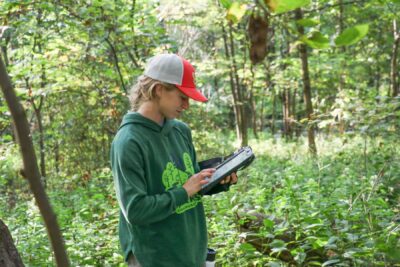
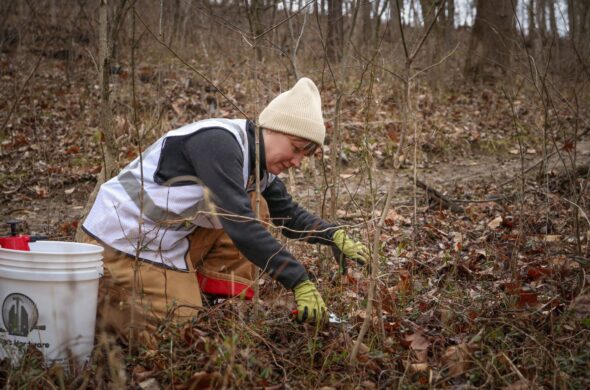
To manage the spread of this invasive species, Olmsted Parks Conservancy is monitoring satellite populations that exist outside of the floodplain of Beargrass Creek. We focus on high quality areas with little to no invasion first to ensure they retain their biodiversity. Then we target the slopes that rise from the creek to protect the sensitive plant populations that occur along the limestone bluffs and rolling hills. While it is impossible to eradicate the buttercup from low-lying riparian areas where water continuously spreads the tubers and bulbils, we can mitigate the spread into areas like the Wildflower Woods Trail. When we keep fig buttercup from spreading further into Cherokee Park woodlands, we can enjoy a variety of native flowers throughout the growing season. While a monoculture of buttercups are visually striking at first, imagine how stunning a mix of Virginia Bluebells, Dutchman’s Breeches and Wood Poppies would be! As you admire Cherokee Park’s spring ephemeral blooms, you are enjoying the work of Olmsted Parks Conservancy’s Team for Healthy Parks!
-Lauren Hendrickson, Natural Areas Specialist
Find something similar: News Cherokee Park