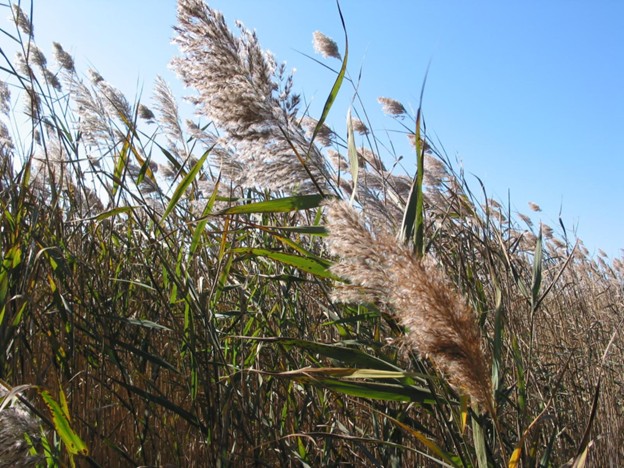
This month, we are talking about Phragmites! This highly invasive reed is spreading to wetland areas in our region. The southwest woods of Iroquois Park became the first site of invasion in the Olmsted Park system, and the Team for Healthy Parks is working to combat its spread. A manageable population size, we plan to showcase “early detection, rapid response” practices to eradicate Phragmites from the parks!
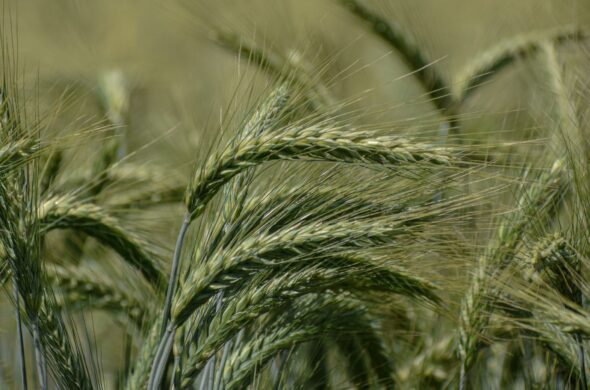
While in the grass family (Poaceae), Phragmites (Phragmites australis, Common Reed) differs from terrestrial grasses that have solid nodes like Big Blue Stem (Andropogon gerardii), by having hollow nodes. Being a type of reed grass, this plant also has a hollow stem, an adaptation to living in wetland areas where they utilize these structures like snorkels and transport oxygen above water to the underwater rhizomes. Phragmites is a highly aggressive invasive plant from Europe that forms dense, monoculture stands 15-20 feet tall. This nonnative outcompetes the native phragmites (Phragmites americanus, American Reed) and most other wetland species. The nonnative stems are tan in color, with blue-green leaves and large, dense seedheads. In contrast, American Reed has reddish-brown stems of 4-7 feet, yellow-green leaves, and smaller, sparser seedheads. Over the winter, leaves of the native reed fall off to display bare stems, while the nonnative retains it leaves on the stem. While the native reed now exists around the Great Lakes, we do not have to worry about misidentification so much, but the nonnative is still affecting our local ecosystems.
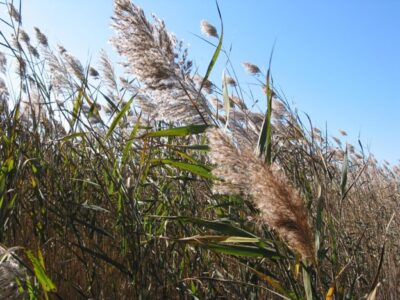
Not only does Phragmites displace native plants, but it also displaces wildlife quicker (as over time, reduction of native plants causes reduction of wildlife in general) as the rigid stalks prevent wildlife from navigating through or nesting in. Stands of Phragmites grow quickly via large rhizomes underground that send up new shoots aboveground. This rapid growth can lower water levels as water is transpired faster than by native vegetation, further deterring wildlife and affecting native plants. The abundant seeds produced by nonnative Phragmites spread across the landscape by wind and water, changing the composition of a wetland to favor a monoculture.
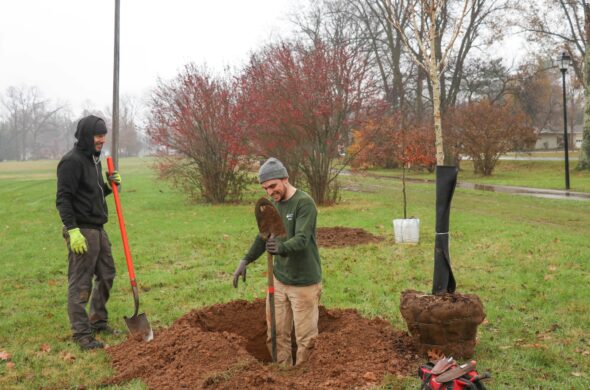
Wetland plants that are locally affected by the invasion of nonnative Phragmites include Swamp Rose Mallow, Sharpwing Monkeyflower, and Silky Dogwood to name a few. The reed is also known to invade orchid habitat, such as the Ladies’ Tresses and Ragged Fringed orchids that occur in niche areas of Summit Field. In the spring, we will monitor if satellite populations emerge from the initial site. Early summer, we will remove aboveground stems via spade and take material from site, using care as fragments can propagate to new plants! Then we follow up with similar treatment a few weeks later, mechanically weakening the underground structures. The best way to help is report sightings of this plant, and support our work by being a member of Olmsted Parks Conservancy! – Lauren Hendrickson, Natural Areas Specialist
Find something similar: News Iroquois Park